

After a particularly rough Monday, I had an irreverent thought:
Theory: God is a masochist.
Evidence: Literally split “Himself” into separate entities (all existing form) just to feel (know) “Himself”.
That’s the cosmic equivalent of chopping your fingers and limbs off just to feel pain.
I would have literally rather felt nothing if it was me. — Journal Entry, December 15, 2025
I couldn’t imagine being in union and deciding to split myself into pieces, to feel separation, to feel pain, to feel finite. I felt so miserable at this point, I just wanted to numb myself.
I’ve been writing almost every day for a month. I’ve been processing years of journals, ripping myself open, reliving the hardest parts of the journey, and then publishing them for strangers to read—because I was compelled to (see The Heart Under the Floorboards)—all while holding down my job, my marriage, my schedule, my “regular” life.
I was so exhausted, drained, and fed up that I would have rather felt nothing at all.
But I sat down to meditate instead.
I don’t know why I’m on my cushion. I don’t know why I lit incense (haven’t done so in probably over a month now). I don’t know why I haven’t got up to fix the Substack now that I know there are things wrong with it. — Journal Entry, December 15, 2025
Eventually, a question arose—not from my thoughts, but from somewhere deeper:
Who taught you to feel awe? Who taught you to feel joy?
As I sat with these questions, I realized I haven’t felt either of those very often in my life. There were some fleeting moments, but I couldn’t remember the earliest instances.
It seemed like we had these in abundance as kids when the world was big, interesting, and inviting—a mysterious adventure waiting to unfold before us. I mostly say that because I still hear that sense of aliveness in the voices of the kids in my neighborhood.
But we lost that at some point. When is unclear. But when did we first learn it?
We didn’t.
Nobody taught you awe or joy—they’re innate. You learned everything else. Namely... suppression. And that education started early.
Sit down and shut up
At one point we had to “behave”.
Maybe it was at church—“Stop fidgeting during the sermon.”
Maybe it was at school—“Hands to yourself. Eyes forward. Don’t speak unless called on.”
Maybe it was the dinner table—“Children should be seen, not heard.”
We learned that our natural exuberance was:
too loud
too much
inappropriate
wrong
So we learned to stop feeling it—not because we chose to, but because we had to survive.
Containment and obedience were etched into us blow by blow from the hammer of discipline.
We didn’t turn into beautiful sculptures though.
We turned into stoic statues with empty eyes and hearts of stone.
And we don’t even realize this until decades later, if at all.
Why suppression = numbing
We don’t even realize how good we’re getting at suppressing until we don’t even feel anything at all. This can manifest as anhedonia (inability to feel pleasure) or dysthymia (persistent low-grade depression). I’ve felt both. Maybe you have too.
But then, even if we do still sometimes feel things, we often aren’t in a space physically or mentally to process them fully.
Maybe we’re at work and it has to wait until the shift is over.
Maybe it’s when we’re out with friends but we have to keep smiling as we’re internally falling apart.
Maybe it’s when we’re out on errands and we just don’t have the time to have a full-on collapse.
If and when we EVER feel physically and emotionally safe to process these suppressed feelings AND have the time in our busy lives—it’s often too scary, too much. It feels like it will crush us if we sit with it for a second longer.
Anesthesia for psychological wounds
So instead of healing it (by feeling it), we numb it:
chemical numbing (e.g. drugs, alcohol)
externalizing the attention (e.g. screens, socializing)
overriding the feelings internally (e.g. excessive porn usage)
Each is a technique to draw the awareness off of one or more “problems” within. Oftentimes those are emotions that spiral into thought loops and manifest as obsessive, anxious, or repetitive thoughts which then feed on themselves to spin up new emotions in response to the chain of events unfolding psychologically.
So we use the mind to fight the mind—or use the mind to numb the mind.
It’s not often we just sit with the mind. But when you do... strange things start to come up.
And you have to keep showing up. Not turning away. Enduring. Persisting. Choosing... with love.
So how do we heal?
Edit: I added the footnotes AFTER I published the post because I realized I still had an unanswered question: Why was it an ocean of milk? I then realized… the realization I had about the mythos unfolding in you during meditation wasn’t a mere hunch… it was scriptural.
There is an ancient Hindu story referred to as Samudra Manthana,1 “The Churning of the Ocean (of Milk)2”. I referenced this towards the end of my early post on Burnout in Tech.
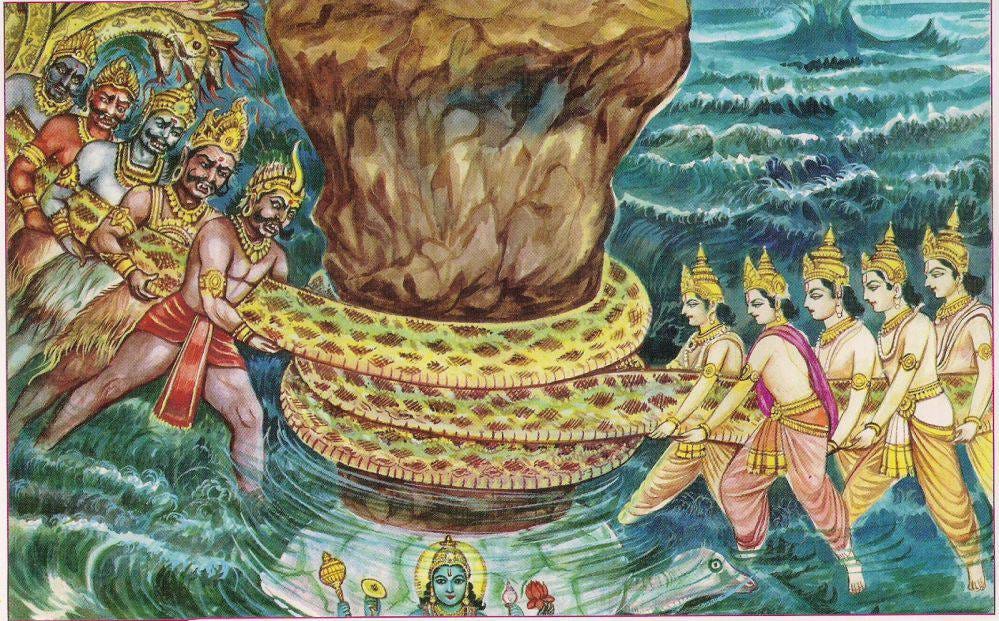
In the story, the devas (gods) in an alliance set out to retrieve the nectar (butter) of everlasting-life at the bottom of the ocean: amrita. They plotted to churn the ocean to reach the depths to do so. The asuras (demons) assisted in the alliance (but were betrayed at the end).
As the devas and asuras churned the ocean, poison emerged. Not from the bottom like sediment stirred up—but from the mouth of the serpent-being that was being used as the churning rope, pulled back and forth by the forces of duality.
As they pulled and endured deaths on both sides from sheer exhaustion, the serpent released poison so powerful it could destroy all of creation.
But Shiva consumed it, held it in his throat, and turned blue from the toxicity. He endured the poison so the churning could continue.
A recognition of embodied mythos
Tonight, I realized something (which I later confirmed in the footnotes below)—This myth unfolds within you—in meditation.
Vasuki isn’t just a mythological snake. Vasuki is YOUR spine.
The asuras and devas? The dualities of embodied life—pleasure/pain, desire/aversion, doing/being.
The churning? Meditation. Sitting in stillness. Turning inward day after day.
The poison? Everything you’ve suppressed. Every emotion you couldn’t afford to feel. Every wound you’ve been carrying.
Shiva? The part of you that can witness it all without being destroyed. The consciousness that says: “I see this. I feel this. And I’m still here.” Your sense of “I Am”.
That shaking you feel in meditation? That’s the rope tightening.
And the amrita—the butter extracted from the violent churning of the milk? The union you’ve been seeking. The aliveness you forgot was yours.
Every time you sit, you’re churning. Every time you stay when you want to run, you’re enduring. Every time you witness the poison without being destroyed by it, you’re Shiva.
And eventually—not in days, not in weeks, maybe not even in this lifetime—the poison is consumed and the amrita rises:
The aliveness you forgot.
The joy that was always yours.
The awe that nobody had to teach you.
You just had to stop numbing long enough to remember.
Is God a masochist?
I don’t actually think so—not if viewed as enduring pain as an expression of Love.
But we might as well be masochists to willingly sit with all of that pain in the presence of only ourselves day after day, no matter what comes up.
It takes dedication that is legitimately harder to maintain when we’re running off of willpower alone after the initial rush of something wears off. It takes commitment. And eventually, you realize it’s YOU who’s enduring pain as an expression of Love.
Wrapping up
I used to think I’d rather feel nothing. That’s what happens when you live in a culture that mistakes numbness for peace. But tonight, a question cut through all of it: “Who taught you to feel awe?”
Nobody did. Nobody had to—because it’s innate. The only reason I forgot was because I was taught to.
So here’s the question I’m sitting with now:
Are you the masochist—willing to feel it all, even when it burns?
Or are you numbing—choosing the slow death of nothing over the terrifying aliveness of everything?
I don’t have the answer yet.
Footnotes
In Sanskrit, a Manthani is literally a churning stick used in a household to separate butter from curds/milk. When the ancient sages named this story, they were explicitly referencing the daily household chore of making butter. They were saying: “This is the Cosmic version of what you do in your kitchen every morning.”
I didn’t realize the symbolism at the time of writing this post. The connection between God/Self and Butter/Milk is explicitly codified in the Upanishads—in the kind of affirmative resonance that made me scream when I found it in texts written somewhere around 400 BCE:
The Shvetashvatara Upanishad, in verses 1.13 to 1.16, states that to know God, look within, know your Atman (Self).[30] It suggests meditating […] with discipline and diligent churning of the sticks unleashes the concealed fire of thought and awareness within.
As oil in sesame seeds, as butter in milk, as water in Srota,[40] as fire in fuel-sticks, he finds in his own self that One (Atman), he, who sees him through Satya (truthfulness) and Tapas (austerity). (15)
He sees the all prevading Atman, as butter lying dormant in milk, rooted in self-knowledge and self-discipline – which is the final goal of the Upanishad, the final goal of Upanishad. (16)