Note: This post discusses the intersection of nervous system function, kundalini awakening, and why these experiences can feel physically intimate. If that makes you uncomfortable, the first two sections (physiology + energetics) stand alone.
TL;DR: If your spine moves on its own during meditation, you’re not having a seizure—you’re experiencing kriyas (spontaneous purification movements). Your nervous system is discharging stored tension, and/or kundalini is clearing blockages. It’s natural, documented, has been happening to meditators for thousands of years. It happens to be using the same neural pathways as sexual arousal. Yes, really. Here's what's actually happening.
During Monday evening’s meditation, my spine did something I didn’t tell it to do. It built, paused, then jolted—a full-body ripple that would’ve been very awkward to explain if anyone had walked in.
So naturally, I had questions such as: What the hell is ACTUALLY going on? And why does it KEEP happening recently?
In particular, this post aims to address the main questions I had:
“What is the physiological correlate? Does it have one?”
“Why is my spine doing this when I’m just sitting upright with my eyes closed?”
“Why is my entire spine shaking like [this] versus shaking like a muscle clenched for too long, especially when I’m relaxed?”
This is an investigation that starts with science, moves through mysticism, and ends somewhere most spiritual teachers won’t go publicly. I’ve marked the sections by depth—read as far as you’re comfortable.
I will lose some people as I go—and that’s fine. I’m here to document and investigate, not to convince anyone.
[Level 0: Technical] The physiological explanation
When you sit in meditation with an erect spine, eyes closed, focused inward, you’re doing something your nervous system almost never gets to do in modern life: You’re giving it permission to discharge stored tension.
Your nervous system has two modes:
Sympathetic (fight, flight, freeze)
Parasympathetic (rest, digest, heal)
Most people live in chronic low-grade sympathetic activation (stress, deadlines, screens, coffee, constant doing).
When you finally sit still—really still, not “scrolling on your phone” still—the parasympathetic system (eventually) activates.
When you give your body permission to let go
As you relax while sitting in stillness (physically and mentally), the nervous system starts releasing trauma, stress, and stored tension that’s been locked in the body for years.
This shows up as:
Trembling
Shaking
Spontaneous movements
Muscle contractions
Spinal undulations
This is documented in:
Somatic Experiencing (Peter Levine, PhD)
Trauma release exercises (TRE - David Berceli, PhD)
Neurogenic tremors (the body’s natural mechanism for discharging stress and trauma)
Animals do this after escaping a hostile situation—they literally shake it off.
Humans? We hold it in for anywhere from days to decades.
While you can burn off stress that’s currently active in the system with exercise (the key recommendation from Burnout by Emily and Amelia Nagoski—GREAT book by the way), what about the stress that DOESN’T get released through physical exertion?
It doesn’t dissipate like heat. It gets stored.
Not just in the mind—in the body... until we sit long enough and give the body permission to finally let go.
Why the spine specifically?
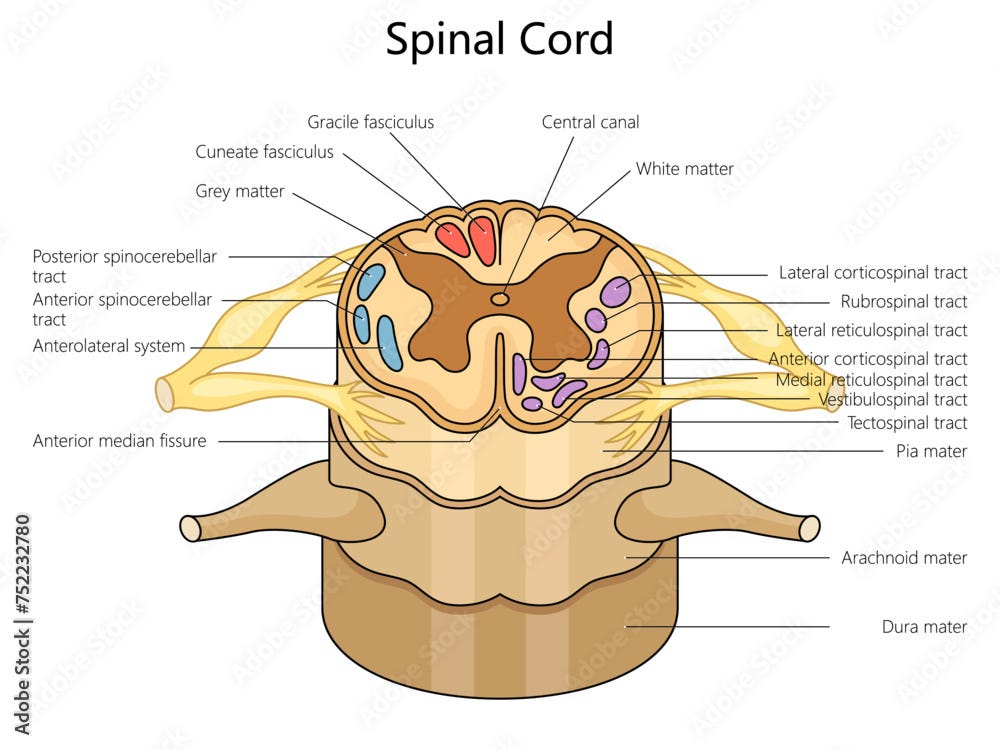
The spine houses:
The vagus nerve—the main parasympathetic highway
The central nervous system—spinal cord
Tons of fascia—connective tissue that stores trauma and memory via tension (see Ida Rolf, “Mother of Fascia”)
When the nervous system starts discharging, the spine is ground zero.
Okay but that doesn’t explain everything
So that’s the physiological explanation—real, documented, scientifically valid.
But here’s what the physiology leaves unanswered:
Why do these movements sometimes follow patterns?
Why do they happen in stages?
Why does it feel like something else is moving through you?
That’s where we move from neuroscience to... something else.
[Level 2: Mystical] The energetic explanation
Now here’s where it gets really interesting.
Spontaneous movements during meditation are called kriyas in yogic tradition.
Kriya = spontaneous purification movement
When kundalini (dormant spiritual energy, called Kundalini shakti in the yogic tradition) starts waking up from no longer being suppressed with constant doing, it moves through the nadis (energy channels) in the spine.
But those channels have often been clogged for decades with:
Suppressed emotions
Unprocessed trauma
Mental conditioning
Egoic resistance
Samskaras (imprints from past experiences)
Think of your nadis like pipes or channels. When they’re clear, energy flows freely upward through the spine. But years of suppressed emotions, trauma, and conditioning act like sediment buildup—clogging the pipes until barely a trickle can pass through. Kriyas are the body’s way of clearing the blockage.
So when kundalini starts moving, it has to clear the blockages. That clearing manifests as:
Shaking
Trembling
Spontaneous yoga poses (e.g. why am I suddenly in puppy pose?)
Spinal undulations
Rhythmic movements
All of these are kriyas—spontaneous movements to purify the body.
You’re not consciously choosing to do these.
Shakti is doing it through you.
Your only job is to get out of the way.
Stages (in my experience)
This doesn’t start as soon as I sit down to meditate, nor is it a single period of movement. There are (usually) phases:
Building - Energy gathers, usually at the base of the spine. This is where the movement starts subtly. Alternatively subtle swaying happens from the mid/upper spine.
Pause - It seems like the movement subsides, slowing down to stillness.
Jolt - Energy ripples through the spine like a shock, similar to a hypnic jerk—the jolt you get when fall asleep sometimes—except there is no dozing off / microsleeping happening.
This can repeat several times in one sit. Sometimes it builds to a peak and stops. Sometimes it’s subtle throughout. There’s no “correct” pattern—your body knows what it needs to release.
The misconception around kundalini
As I discovered in my investigation, the above stages depict textbook kundalini activation.
I used to think it was a single mind-blowing eruption.
It’s not.
This misconception is why I’ve seen others in spiritual communities (specifically HealthyGamer in my experience) express confusion about why they’re experiencing rocking and shaking in their meditation practice.
This is kundalini moving. It’s a natural side effect of deepening practice.
I can’t tell you how long it takes to encounter this (it’s different for everyone because everyone’s blockages are different).
For me, I’ve noticed it become more common since entering what’s been referred to as “The Dark Night of the Soul”, a purification stage from spiritual attachments (not merely a period of hardship).
Content Warning: The next section discusses why kundalini movements feel sexual. If you’re not ready for that conversation, this is a good place to stop. The physiology and energetics above are complete on their own.
[Level 3: Union] Why the spine moves that way
Now we get to the question everyone's thinking but nobody wants to ask:
Why do these spontaneous spinal movements in meditation sometimes feel rhythmic, wave-like, or even sexual in nature?
It’s because it’s utilizing the same neurological pathways—the same nerve networks that govern:
Orgasm
Deep emotional release
Kundalini rising
These are all connected and all involve:
Parasympathetic activation
Pelvic floor engagement
Spinal oscillation
Rhythmic contractions
Surrender of conscious control
So when your spine starts moving on its own in meditation, it’s accessing the exact same hardware that governs sexual arousal and release.
The spinal undulation of kundalini rising is biomechanically identical to the spinal undulation of orgasm:
same muscles
same rhythm
same surrender
same mechanism
same energy moving through the same channels
The key difference? The direction and endpoint of said energy.
Sexual energy:
Moves down and out (release)
Dissipates into the physical
Temporary pleasure
Depletes (you feel tired after)
Kundalini:
Moves up and in (sublimation)
Concentrates into the spiritual
Permanent transformation
Energizes (you feel activated)
This isn’t new—it’s been suppressed
This connection between sexual and spiritual energy has been known for millennia:
Tantra (Kashmir Shaivism’s Vijñāna Bhairava Tantra, particularly verse 68) explicitly uses sexual energy for spiritual awakening
Taoim emphasizes jing (sexual essence) retention to nourish the spirit (shen)
Yoga teaches brahmacharya—not celibacy for its own sake, but conservation and redirection of virya (vital energy)
Every mystical tradition knows this. Most just won’t say it plainly. Because if people knew that the pathway to God runs through the same nervous system as sex?
Everything would change.
No priests needed. No intermediaries. Just your body, your breath, and direct access to the Divine.
That’s dangerous. Not to people—to power structures.
Ida Craddock learned this the hard way. In 1902, she was imprisoned and driven to suicide for teaching what I just experienced on my meditation cushion: sexual energy and spiritual energy are the same force. She called it a “mystico-erotic religion.” The authorities called it obscenity.
123 years later, I’m sitting here writing about spontaneous spinal kriyas that feel uncomfortably intimate—and realizing these “obscene” teachings were right. It’s all one energy.
Tantra didn’t invent this. Tantra just refused to pretend that spirit and body were separate. It’s a path for people who can’t renounce the world—who live with partners, have jobs, raise families—and still seek union with the Divine. It’s the “weaving together” (the literal meaning of tantra) of what we were taught to keep apart.
Still with me? Good. Let’s wrap this up.
If you’ve experienced “spontaneous spinal movement” during meditation
You’re definitely not alone.
It can be confusing or concerning to encounter for the first time and you might even wonder if it’s some kind of seizure.
But this is a phenomenon that’s been extensively documented, just not necessarily in terms common to the typical Western meditator.
You’re not crazy.
It’s real. It’s natural. Your body knows what it’s doing: clearing the blockages you didn’t even realize you’ve been holding all these years. Allow it to move—you might discover it knows more techniques than you do... and exactly which ones you need.
If kriyas become too intense:
Open your eyes
Touch the ground
Take a few deep breaths
End the session early if needed
Kundalini awakening isn’t a race. You don’t get bonus points for enduring more intensity than you’re ready for.
Wrapping up
If you’re experiencing spontaneous movements in meditation—even if they feel strange, even if they feel too intimate—you’re not broken. You’re awakening.
Spinal movements arising in meditation aren’t a sign that something is wrong with you; it’s a sign you’re letting go of tension that’s been stored in your body unconsciously.
You can’t force kundalini with substances, postures, or conscious movement. Like sleep, you can only create conditions for it to arise naturally.
When it does? Let it move. Trust the body and get out of the way.
Update (Dec 23, 2025)
Since publishing, I had 3 experiential realizations about the mechanics of spinal kriyas:
1. Resistance impedes flow
Physical tension acts as impedance; you cannot muscle your way into a Kriya. Just like a wire, introducing resistance WILL hinder the flow of Shakti.
Experience: During meditation yesterday, I noticed my spine wasn’t moving. Then I realized I was unconsciously holding tension in my shoulders. When I did a full body scan and softened every muscle (while maintaining posture), it felt like an energetic faucet opened. A moment later—jolt.
2. The spine must be balanced, not just upright
The goal isn’t rigid military posture. The spine must be balanced like a tent pole. If you are leaning even slightly, your micro-muscles seize up to hold you, creating resistance (impeding the flow as mentioned above).
Experience: When I found the “zero-point” of balance where my muscles went slack during today’s meditation, the energy moved freely and kriyas arose.
3. Manual Pressurization (The Dispenza Protocol)
I entered a session with low energy (expecting nothing), but decided to test the breathwork technique from Dr. Joe Dispenza’s Becoming Supernatural (essentially a variation of Mula Bandha plus and Uddiyana Bandha).
The Method: Deep inhale, squeeze the perineum and abdomen, and visualize the energy in the spine flowing rapidly upwards to the center of the brain.
The Sensation: My heart pounded like a hydraulic pump was over-pressurizing the system.
The Outcome: Despite my low energy, the “shaking” returned immediately and strongly after the release of the breath and locks. It appears you can manually override a “low battery” state with sufficient hydrostatic pressure.
Halfway throughout this practice, I was seeing flashing behind my eyelids. Turns out the candle on my altar was flickering periodically—despite no HVAC/airflow changes in the room. Correlation? Causation? I don't know. But the timing was notable. It stopped shortly after I opened my eyes.
[Level 3: Union] P.S.
Don’t be surprised if different kriyas arise after the spinal movements and meditation ends. As I was still sitting on my cushion typing up the questions to bring up in this post, my body on its own shifted into the sahajoli mudra—the exact mudra (for women) associated redirecting vital/sexual energy upward through the central channel, transmuting base energy into refined spiritual essence by subtle, rhythmic contractions of the pelvic floor.
I didn’t plan it. I didn’t even know I was doing it until I noticed the contraction and thought, “Wait, what is my pelvic floor doing?” Then I looked it up.
And to be blunt? If you’re a woman you likely already know how to do it. You might recognize it as that move you do when you’re too tired to keep at it during intimacy.
Once again: being becomes doing, NOT the other way around. You don’t learn the practices and then awaken. You awaken, and the practices arise spontaneously as symptoms.
Your body already knows what to do.
Your job?
Trust the process (even when it’s terrifying, even when you don’t understand it, even when your mind is screaming “what is happening”)
Get out of the way and let it move
If you’ve read this far and you’re thinking “this sounds insane”—you’re not wrong. It IS insane by consensus reality standards. But it’s also documented, natural, and happening to more people than will admit it publicly.
If you’re experiencing this and feeling alone—you’re not. You’re just early to a conversation that’s been suppressed for centuries.
Welcome to the Field Notes.