

“Ah yes, the soothing sound of Pissing Into a Serene Lake.”
That thought came to me mid-sphinx pose at my Tuesday night yoga class when the most obnoxiously loud water sound effect blared through the studio speakers. It was so loud the instructor had to get up and turn it down.
I was lying in the front row, eyes closed, trying desperately not to laugh.
That’s when I realized: this is EXACTLY what’s wrong with modern yoga.
Before I even went to the class, I was doing some yin poses for grounding after my post-work meditation session. During this I was wondering about how yoga in the West got so... sterilized for lack of a better word.
Questions this post seeks to answer (or at least get you wondering):
Why does yoga class feel so hollow / like spiritual bypassing in Lululemon?
What is yoga ACTUALLY supposed to be?
How did it get this way?
Brief history
Originally, the word “yoga” meant “union”—union with the Divine. But in the West that word has somehow come to be associated with exotic stretching with a few Sanskrit names thrown in. Yoga was stripped to its bare bones and exported to the West in a format that could be taught in group settings—at your local YMCA, or at a suburban studio like the one I attend.
In order to write this post, I did some research and was pleased to find that this topic has actually its own Wikipedia article already: https://en.wikipedia.org/wiki/Yoga_in_the_United_States.
I’ll try to summarize it as best I can.
Early “pure” introduction
Yoga was introduced in America in the late 19th century, almost entirely as intellectual and spiritual.
Philosopher and poet Ralph Waldo Emerson expressed yoga as philosophy (and was mocked mercilessly) for his “Brahma” poem in 1857.
Hindu leader Vivekananda taught it in 1893 as a rigorous spiritual path of meditation and breathwork (pranayama). Notably, he rejected the physical postures (asanas) and hatha yoga entirely, focusing purely on the inner work.
The shift to physical practices
The “sanitization” began when teachers realized Americans were more interested in health and beauty than spiritual liberation.
The practice of yoga as consisting mainly of physical postures began in 1919 when the pioneer of asana-based yoga, Yogendra, brought his system, influenced by physical culture, to the United States.
In 1948, yoga got its Hollywood makeover when Indra Devi opened a studio there. She is credited with making yoga “glamorous” and acceptable to American women by framing it not as a religious ritual, but as a beauty and health regimen for celebrities like Gloria Swanson.
Mass media “whitewashing”
The most explicit example of sanitization in the article comes from Richard Hittleman, who launched the TV show Yoga for Health in 1961.
He strategically omitted or minimized esoteric aspects like kundalini and the subtle body in order to sell millions of books and keep his TV audience from changing the channel.
Although he personally believed the goal of yoga was “pure bliss consciousness,” he presented it publicly as a practical method for physical health, removing the “threatening” non-Christian spiritual elements for the average American.
Other yoga television shows followed, including Lilias Folan’s WCET series Lilias, Yoga and You!, which ran from the 1970s to the 1990s, helping to make yoga acceptable to the American public as well.
Modern fitness focus
By the late 20th century, the transformation from “spiritual union” to “fitness routine” was nearly complete.
Ashtanga Vinyasa Yoga arrived in 1975 with continuous flowing movement that connects yoga poses together called vinyasas. It gave rise to a spinoff called Power Yoga in the 1990s.
In 1974 there was the creation of Bikram Yoga, also known as hot yoga with studios heated to 105F (41C).
These all turned the practice of yoga into an energetic, sweaty, aerobic exercise.
Cosmopolitanism
The Wikipedia section “Cosmopolitan yoga” is basically all my complaints with actual references. To pull some particular powerful quotes (emphasis my own):
[The historian Jared] Farmer identifies 12 general trends in yoga’s history in the United States from the 1890s to the 21st century:
peripheral to central; local to global; male to (predominantly) female; spiritual to (mostly) secular; sectarian to universal; mendicant to consumerist; meditational to postural; intellectual to experiential; esoteric to accessible; oral to hands-on teaching; textual to photographic representations of poses; contorted social pariahs to lithe social winners.
Considering all these trends, Farmer stated that modern yoga as exercise belonged to Srinivas Aravamudan’s category of the “global popular”, which Farmer glossed as “a postcolonial realm of religious cosmopolitanism.”
In Lasater’s view, American yoga in the 21st century has lost “the gentleness, consistency, and direction of the practice”, replaced by ambition. Lasater believes that many Americans “have conflated asana with yoga.”
History summary
In short, since yoga’s introduction in America about 150 years ago, it was converted from a practice of spiritual union into a secular consumer product.
What was originally included
So now that we’ve established that largely the spiritual side has been cut from modern yoga in America (outside of ashrams and temples that seek to preserve its roots), let’s cover what was originally included before it was secularized to the American public as a fitness routine or stress relief practice. Let’s talk about what yoga was before it became stripped down to just asanas (and maybe some breathwork if you’re lucky).
So what exactly was lost in translation? To understand that, we need to look at what yoga actually consisted of before it became a fitness trend.
The missing limbs of yoga
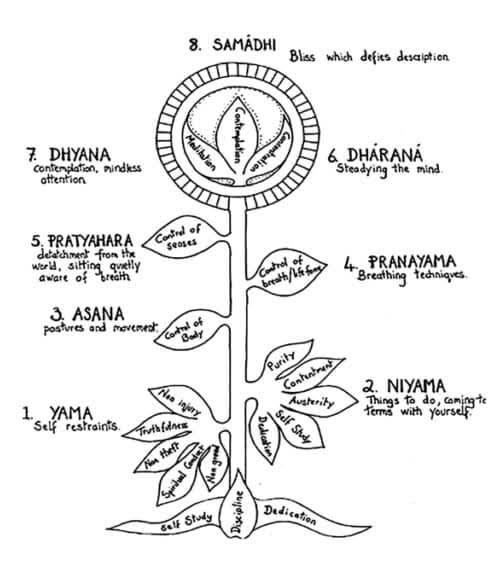
The Yoga Sutras, written by sage Patanjali (who lived somewhere around 2nd century BCE and 5th century CE), are widely regarded as the authoritative text on yoga. They outline the eight limbs or “branches” of yoga.
It’s helpful to approach this with the understanding that each “branch” that was cut from the ancient tree of yoga builds upon the previous one.
Most Westerners think yoga = asanas (physical postures). So let’s start there, even though asana is actually the third branch of yoga’s eight-limbed path. We’ll build up from what you know to what got left out in order to appeal to the American mass in the past century.
Here’s a diagram to visually understand the branches:
4th Branch: Pranayama
Asana is a way to move energy (prana) around the body physically. This can be experientially observed by most people.
You stretch to feel more awake don’t you? It doesn’t have to be reaching your toes; it can be as simple as stretching a tight neck, reaching your arms overhead in bed, or leaning side to side to stretch a sore back.
Pranayama is simply moving that energy around with the breath instead of stretches. You can also confirm this for yourself by changing the rate of your breath or the duration of your inhales and / or exhales.
If you’re feeling anxious, you’re likely hyperventilating or taking shallow breaths with short exhales. This is the reason that many wellness apps or restorative / yin yoga classes will encourage the extension of the exhale—in order to calm down into relaxation and activate the parasympathetic nervous system.
Conversely, you can get yourself more activated, awake, and stressed if you start purposely hyperventilating. You’re pushing more energy through the system / bringing more in with the rapid breaths.
5th Branch: Pratyahara
Now, when the energy can be directed with the body (asanas) and the breath (pranayama), we have 4 questions to answer:
How can we concentrate that energy?
Where do we concentrate it?
What happens when we concentrate it?
Why do we concentrate it?
Pratyahara answers the first.
It means to withdraw the senses (sight, hearing, smell, taste, touch). That means:
Not focusing on the fake water soundtrack on Spotify
Not huffing eucalyptus essential oil pouring out of a $25 Amazon diffuser
Not distracted by complicated flows or sweat pouring off your body from the overheated studio
Just... turning inward. That’s it. That’s the practice.
6th Branch: Dharana
Once the energy has been awakened with movement and breathwork and the awareness has been withdrawn inward by turning away from the senses, concentration must unfold next to prevent the mind from becoming lost in the only sensory stimulation left: thoughts.
Dharana answers the second question of “Where do we concentrate the energy?” For many this can be the breath or an internally repeated mantra, ideally something steady and arising with little to no effort.
This is where:
Modern yoga gives you all of 2-5 minutes of “savasana” (corpse pose) at the end of class to “go inwards” before “returning to your body by wiggling your toes and fingers.”
Seated meditation or yoga nidra (meditation while in savasana) would fit in if modern yoga was more of an esoteric practice.
The focusing on the breath or mantra starts to become powerful—when the previous branches have been honored in the practice.
7th Branch: Dhyana
This answers the question, “What happens when we concentrate?”
Over time concentration becomes less effortful and instead absorption into the breath or mantra itself unfolds. This is where people will begin to make mystical statements of “becoming the breath,” “becoming the vibration,” or “becoming the practice”.
At this point, you are still aware and sense oneness with the object of your (effortless) concentration (because absorption requires no effort like water into a dry sponge).
This level isn’t casually reached, not with a couple yoga classes a week, especially with no built-in meditation longer than a few minutes with how busy and hectic our modern lives are.
8th Branch: Samadhi
This is the ultimate goal of yoga, answering the question “Why do we concentrate the energy”?
Samadhi is a state of pure awareness, where the absorption isn’t into the object of concentration, but transcending the object so that awareness is absorbed into itself.
I’ll save the deep dive on samadhi for a Level 2 or 3 post, but here’s the essence: this is the blissful state that unfolds when the original meaning of yoga is realized: union with the Divine (the awareness).
My lamentation for modern yoga
Here’s my honest confession: I go to yoga class regularly, and it consistently feels less meditative than anything I do at home in my sacred space. And I don’t know how anyone is supposed to be practicing pratyahara with the stupid playlists and the running water noise from the diffuser (but maybe that’s just me).
Comedic timing
What’s funny is I wrote the above paragraph complaining about the playlist at yoga class, immediately went off to my Tuesday night yin + hatha + vinyasa blend class, and right in the middle of it, the most obnoxious running water sound yet came on for one of the tracks. It was so loud that the instructor had to get up and turn the speaker down.
I was thinking to myself, “man, that sounds like pissing” and then I don’t even know what in my head was like, “ah yes, the soothing sound of Pissing into a Serene Lake”. I was lying up front in sphinx pose with my eyes closed and a stupid grin on my face trying desperately not to bust out laughing. So that’s how this post got its title.
I can’t help but feel like this experience was in direct response to my complaint which is partially why it was extra funny. Normally, sounds like this irk me (misophonia anyone?), but tonight I was able to genuinely smile about it rather than get annoyed (because the only other alternative was to start snickering for no reason in the middle of class).
But now I’m left with the mystery: was it the still small voice or the personality who cracked the joke? Does it matter? Either way, I smiled instead of getting annoyed. Maybe that’s the point.
Practical suggestions
If you feel like yoga class is missing something, you’re not wrong. Here’s what to try at home1:
3 rounds of sun salutations (surya namaskar) to move the energy.
10 minutes of alternate nostril breathing (nadi shodana) to balance the energy.
20 minutes of seated meditation (eyes closed, no music, quiet environment, focusing on breath or an easy mantra) to concentrate the energy.
Wrapping up
Yoga isn’t about touching your toes. It’s about union. And you can’t unite with the Divine if you’re distracted by the sound of someone pissing into a serene lake.
So turn off the playlist. Sit in silence… and see what happens.
P.S.
Update (Dec 27, 2025)
If you’re wondering why yoga has become exotic stretching with a Spotify playlist, I just finished the investigation. It turns out this wasn’t an accident—it was a systemic process to make the soul profitable. Read the full report here: The Numinous Neutered—How the Soul Was Industrialized for Profit
Footnotes
⚠️ Fair warning: If you do this practice consistently for a few months, you might accidentally catapult yourself into what mystics call “The Dark Night of the Soul.” I’m not kidding. See my Level 1 and Level 2 sections on here for what that actually looks like.