

I feel like Prometheus if he stole the fire of the Burning Bush.
It’s not God.
It’s Creativity—the right hemisphere given voice through the left’s language.
I’m not a psychologist.
I’m not a neuroscientist.
I’m someone who once let my left side run the show somewhere along the way. And not long ago, the show-runner got tired.
On left-dominance
I’m becoming increasingly convinced the more research I do that spiritual experience is just right hemisphere activity in a left hemisphere dominant society.
What surprised me is that I’m not the first person to posit this.
British psychiatrist, philosopher, and neuroscientist Iain McGilchrist spent 600 pages arguing in The Master and His Emissary that Western culture has been systematically tilting toward left hemisphere dominance since the Renaissance through the Reformation, the Enlightenment, the Industrial Revolution, and into now. Each era a little more analytical. A little more literal. A little more suspicious of exactly the kind of experience the mystics were pointing at.
I haven’t read it yet. I’m about to.
On “exiting left”
The topic of lateralization has been on my mind since I wrote a post a few weeks ago about perception and neuroanatomist Jill Bolte Taylor’s “stroke of insight” which completely altered how she perceived her sense of self as she lost functionality in her left hemisphere.
Just yesterday, I was reading about how to actually activate the right hemisphere. One method is to read, decode, or write highly ambiguous, poetic, or unfamiliar metaphors. Unlike literal language or common clichés—which the left hemisphere handles automatically—processing novel metaphors requires the broad associative networks of the right.
What’s interesting is this would explain why spiritual and religious texts are written the way they are. Koans. Paradox. Symbolism. Poetry. Why the “Truth” is always described as ineffable:
The Tao that can be spoken is not the eternal Tao. — Tao Te Ching, Chapter 1
The mystics, saints, and prophets weren’t being cryptic for the sake of it. Whether or not they were aware of it, they were engineering a left hemisphere bypass. The ambiguity was the whole point, a recurring pattern across traditions.
But engaging with esoteric texts isn’t the only method to activate the right hemisphere.
You have two names
Last night I felt myself being called to put down Everything before collecting the missing 2% of things in the game (as the completionist in me wanted) to go sit at my cushion.
Based on my research of ways to quiet the left hemisphere and activate the right, I decided to stack several methods simultaneously: open monitoring meditation, blocking the right nostril for left-nostril breathing only, and whispering one word rapidly on repeat the entire time.
This is what happened:
My eyes rolled up into my head on their own and I had a realization: [My name] is the name of the left hemisphere. “I Am” is the name of the right.1 — Field Note, March 3, 2026
The experiencer has a name. You just forgot it.
My experience
Somewhere along the line, my right hemisphere skills atrophied.
I stopped making art before college. I became increasingly analytical as a coping mechanism—compensating for the shock of actual difficulty when computer science, engineering, and calculus hit me all at once. I pushed deeper into the left side until I became alienated from who I even was and what I wanted outside of my career.
Then I burned out.
And since then? I’ve been unwittingly reconnecting with the alienated half.
Through meditation.
Through imagination.
Through repetition.
Through poetry.
Through stories.
And now—this Substack.
I have a sabbatical coming up where I intend to test this hypothesis directly: that starving the left while feeding the right will produce more of what the traditions called mystical experience. I’ll be doing a 10-day silent retreat followed immediately by a 10-day dark retreat at Hridaya Yoga in two months.
We’ll see what comes out of the dark.
Technically is my ego.
Mystic is my soul.
And I’m trying not to lose either of them in the process.
P.S.
After the meditation, the realization, and most of this post was drafted, I went back to the Everything game and found these quotes waiting for me before the rest of the achievements in the game somehow unlocked without me really doing much of anything:
There are two inseparable halves, the object—which has divided itself into everything through space and time, and the subject perceiving it, which is not in space or time, but only in the present. Every idea of the world dies along with every subject of it.
I’ve given up trying to prove I exist. The proof will be gone soon enough. All I have is myself.
Above me is a watery abyss of no definite form, which can hold my stare forever. It’s me looking at me.
We will continue on our paths as long as we exist here. They might never cross again, or I might see you a thousand more times. You might forget this moment for the rest of your life, or you might have forgotten it already. In any case, you should know that I love you.
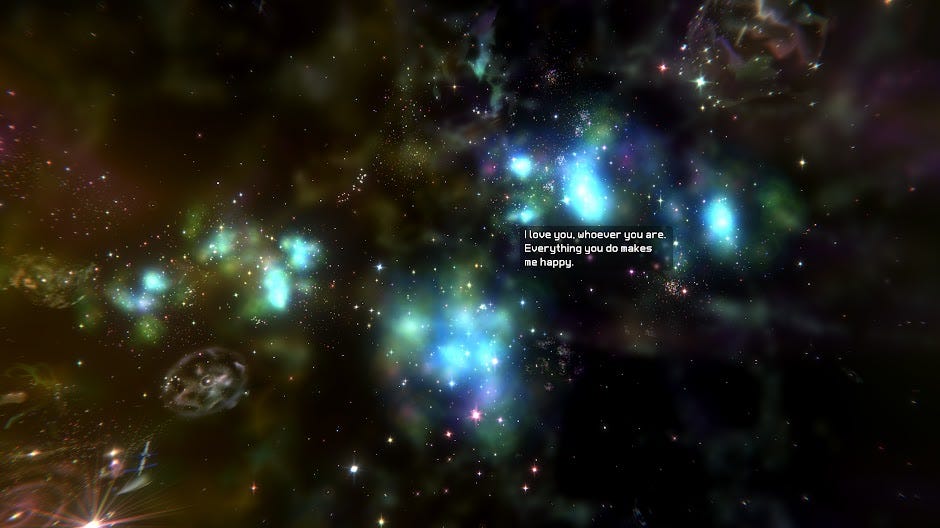
Make of that what you will. But I highly recommend this game.
Footnotes
Taylor locates “I am” in the left hemisphere as the ego asserting separation. What I experienced as “I Am” is its opposite—a sense of Being before identity arises, before a name or label is attached to beingness.