

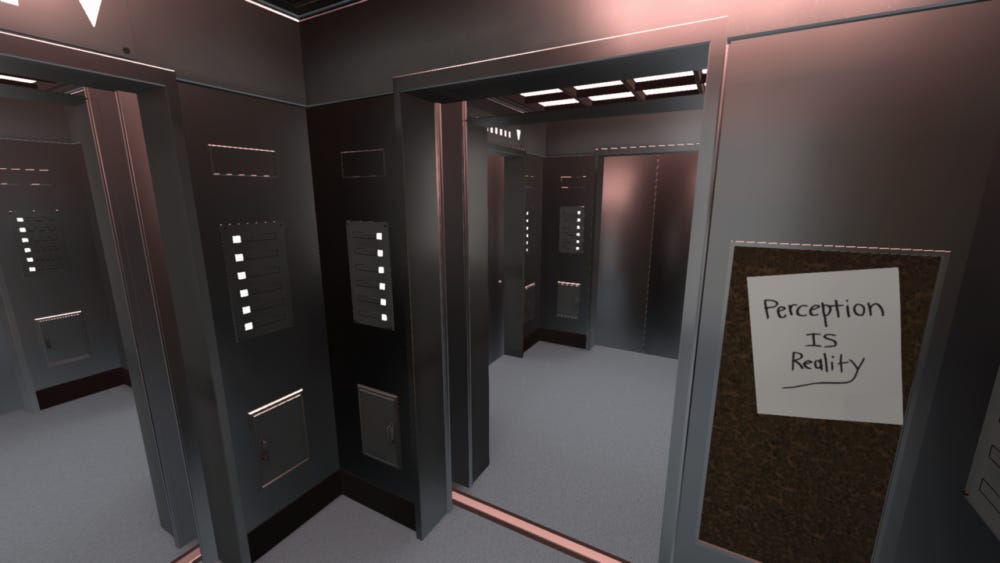
I finished a video game at midnight and was up until 2 AM crying. Not because it was sad. Because it struck a nerve.
Superliminal is a puzzle game from 2019—surreal, funny, reminiscent of The Stanley Parable. The core mechanic is that the size of objects is determined entirely by how you look at them. Pick something up close and it becomes enormous. View it from a distance and it shrinks. Change your position in space and solutions appear that were completely invisible two feet to the left.
I played for hours finding solutions hidden in plain sight and other easter eggs. But then the final two levels landed the entire game’s message—about how people get stuck, how hopelessness is often just a fixed perspective mistaken for reality—and something in me broke open.
I was exhausted after a long day, but went to my cushion at 1 AM and grieved. For myself. For everyone I know who is suffering inside a perception they can’t see past. For humanity collectively, pressing against the same walls, unable to conceive that the room might look completely different from a different angle.
I cried for an hour before eventually going to sleep.
In the stillness the next morning, something arrived that I hadn’t been looking for: the realization that the illusions of the game and those of our daily life aren’t so different.
The voice that runs the show
There’s a part of you narrating this sentence right now.
It’s the voice that says “I am”. The voice that knows your name, your job title, your history, your fears. The voice that maintains the story of a separate, continuous self moving through time—making choices, taking credit, assigning blame.
This is the ego. Not in the psychological sense of arrogance, but in the original sense: the sense of doership. The feeling that there is a “you” who is doing things, rather than a perspective of awareness watching things unfold.
It feels like the whole of you. But consider what it doesn’t control:
Is it you who digests your food?
Is it you who heals your bruise?
Is it you who beats your heart?
Is that the same “you” choosing what to wear in the morning?
How would you know you’re not unconsciously fabricating a story about your choices, layering a sense of “I, the decider” over processes that were already in motion?
Neuroscience suggests this is exactly what is happening.
What Superliminal understood
The game’s narrator puts it plainly:
“More often than not, the problem is not that the problems we face can’t be solved. The problem is that we become so afraid of failure that we refuse to see our problems from a new perspective—and so we do the same things again and again and again. And therein of course, we find exactly the failure we were looking for.” — Dr. Glenn Pierce
The analytical mind locks in a perspective and calls it reality. And the most common perspective it locks in is limitation—the sense of a small, separate “me” in relation to everything else, managing, striving, failing, trying again.
When that perspective is fixed, suffering becomes invisible to itself. It doesn’t know it’s a perspective. It thinks it’s just the way things are.
What a stroke revealed
Dr. Jill Bolte Taylor is a Harvard-trained and published neuroanatomist, whose research specializes in understanding how our brain creates our perception of reality.
In 1996, she suffered a massive hemorrhage in the left hemisphere of her brain. Over the course of four hours, she lost language, memory, and the sense of herself as a separate person. She later gave a TED Talk and wrote a book about what she experienced from the inside.
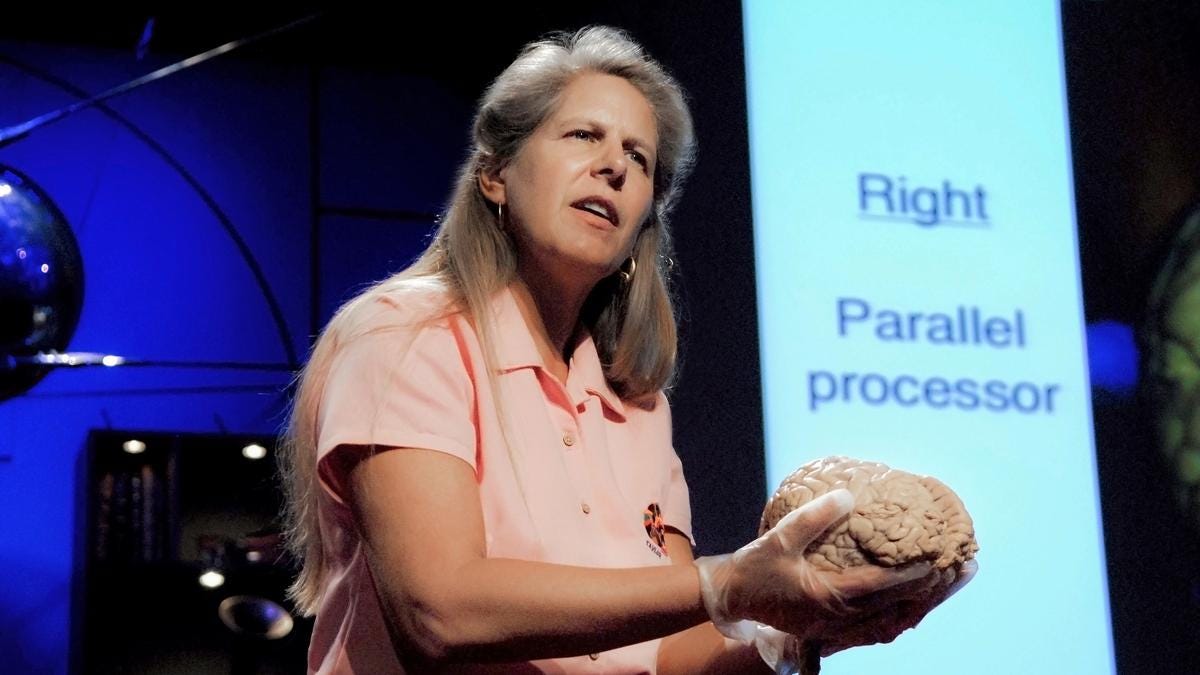
On the left hemisphere—the one she was losing:
“It’s that little voice that says to me, “I am. I am.” And as soon as my left hemisphere says to me “I am,” I become separate. I become a single solid individual, separate from the energy flow around me and separate from you. And this was the portion of my brain that I lost on the morning of my stroke.”
On what remained when it went quiet:
“My brain chatter went totally silent. Just like someone took a remote control and pushed the mute button—total silence. And at first I was shocked to find myself inside of a silent mind. But then I was immediately captivated by the magnificence of energy around me. Because I could no longer identify the boundaries of my body, I felt enormous and expansive. I felt at one with all the energy that was. And it was beautiful there.”
A Harvard brain scientist accidentally lost her left hemisphere and described what mystics have been pointing at for centuries.
The ego isn’t you. It’s half of you. And it’s been doing all the talking.
What arose from the silence
I didn’t need a stroke to glimpse what Taylor described. I just had to sit still long enough for the narrator to go quiet.
This arrived in meditation about 3 weeks before I played the game, before I’d read a single word of Taylor’s work:
The body was always moving on its own—we just thought we were moving it. When conscious thoughts stop, the body still moves. Thoughts are fast, but not faster than the body. Thoughts can hijack the body, but the body knows how to move on its own. — Journal Entry, January 30, 2026
The intelligence that knows how to run your heart also knows how to move your body. The narrator just takes the credit.
What this costs us
This is why I was crying at 1 AM.
Not because any of this is new information. But because of what it means that most people will never encounter it—that most will live their entire life inside a fixed perspective, staring at walls like a cage because it was assumed that they were solid on all sides.
The suffering caused by fixed perception is not a small thing. It is the texture of most human lives—the anxiety that won’t lift, the hopelessness that feels permanent, the sense of being trapped in a story you didn’t choose and can’t escape.
And the exit isn’t complicated. It’s just unfamiliar.
Dr. Taylor says it plainly at the end of her TED Talk:
“We have the power to choose, moment by moment, who and how we want to be in the world. Right here, right now, I can step into the consciousness of my right hemisphere where we are — I am — the life force power of the universe, and the life force power of the 50 trillion beautiful molecular geniuses that make up my form. At one with all that is. Or I can choose to step into the consciousness of my left hemisphere, where I become a single individual, a solid, separate from the flow, separate from you.”
The game said it too, in its final moments:
“In a few minutes, you’ll be back in the real world, and some part of you will say that none of this was real. So how could it have meant anything? But—just like the power of perspective itself—it will have been as real as you believed it to be. All you’ve got to do is wake up.”
I’m still sitting with the grief. I don’t think it goes away.
But I’m also sitting with this: the exit exists. It has always existed. It’s just two feet to the left of where you’re standing.